Can Permanent Makeup Regrow Eyebrow Hair in Alopecia? What Can Honestly Be Said
Brow loss can be one of the most emotionally significant parts of alopecia.
Even when someone has adapted in other ways, the loss of eyebrows often changes how the face feels, how expressions read, and how recognizable someone feels to themselves in the mirror. That is one reason eyebrow restoration becomes such an important part of the conversation for many people living with alopecia-related eyebrow loss.
At Ellebrow, we approach this topic carefully. Eyebrow permanent makeup (PMU), including techniques such as nano brows and microblading, is first and foremost a cosmetic restoration service. Its primary role is to recreate shape, definition, softness, and presence where natural brow hair has become sparse, patchy, faint, or absent. Whether someone is researching permanent makeup, microblading, or nano brows for alopecia-related brow loss, that core role stays the same.
At the same time, there is a more intriguing question that sometimes sits quietly in the background. Could eyebrow permanent makeup ever overlap with something more than appearance alone? Not in the sense of a marketed treatment claim, and not in the sense of a promise, but in the narrower sense of whether controlled tattooing of the skin could ever coincide with some return of natural brow hair in select alopecia cases.
An unusual case, real-world observations, and the limits of what can honestly be claimed
The published report that sparked wider interest
Much of the curiosity around this subject traces back to a published case report describing complete scalp hair regrowth after full-scalp tattooing in a patient with alopecia universalis.[1]
That kind of report is naturally attention-grabbing. It is unusual, memorable, and difficult to ignore.
But unusual is not the same as conclusive.
A single case report can raise a serious question without proving a mechanism. It can suggest that something may be worth studying more closely while still falling far short of showing that tattooing itself caused the regrowth. That distinction matters even more in alopecia because forms within the alopecia areata spectrum are known for a variable, often relapsing or remitting course, and spontaneous regrowth can occur in some patients.[3]
That is why this topic deserves curiosity, but also restraint.
Why the question is not unreasonable
Even without strong direct evidence, the question does not come out of nowhere.
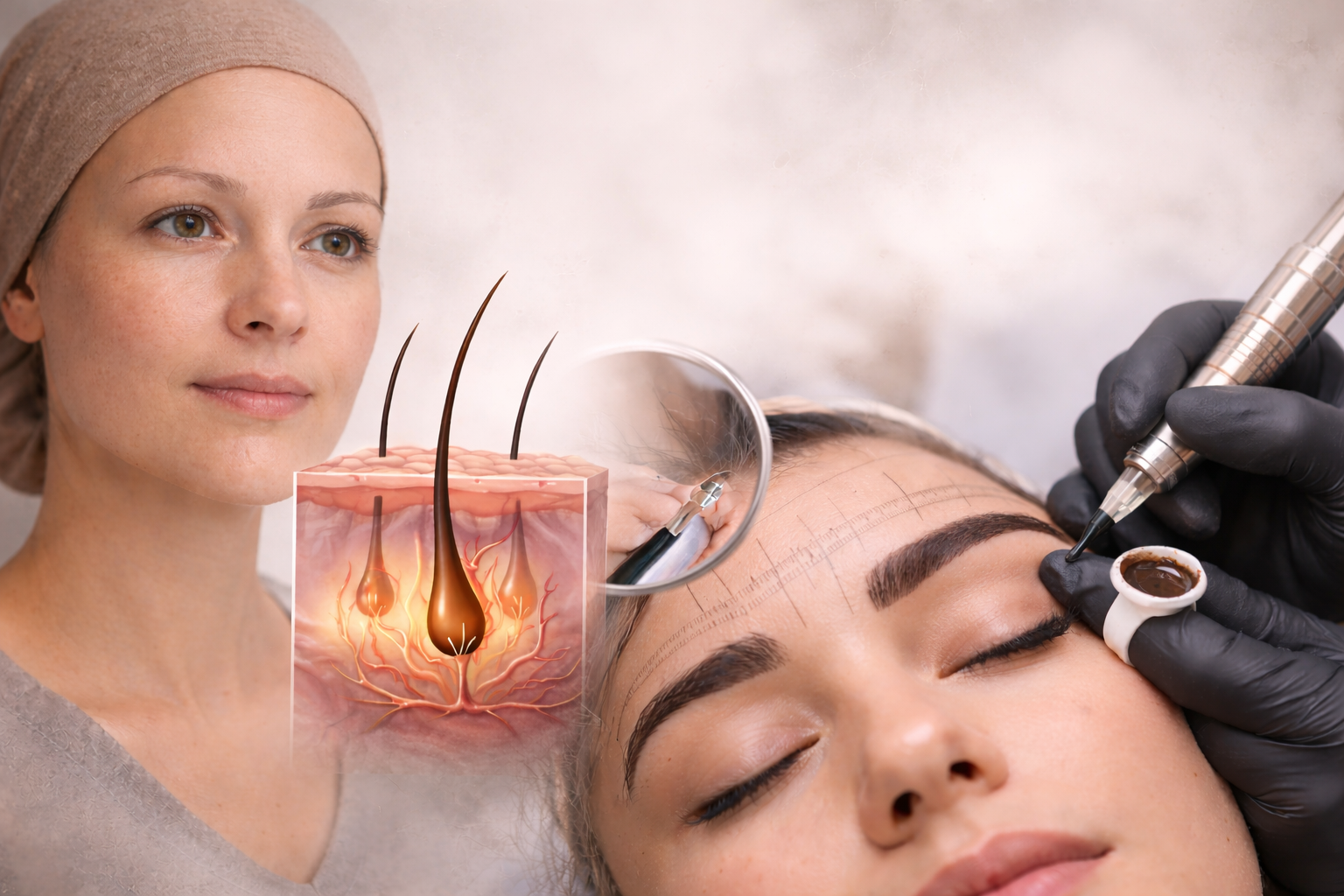
Cosmetic brow tattooing involves controlled, localized needling of the skin. Whenever skin is repeatedly and intentionally injured in a precise way, the body responds with local healing signals. Those responses can involve inflammation, repair activity, vascular changes, remodeling, and communication between cells in the treated area. Hair follicles exist within that same local environment.
That does not prove eyebrow permanent makeup can restore hair. It does help explain why some people find the question biologically interesting rather than purely speculative.
A second layer of interest comes from adjacent scientific discussion. A follow-up letter responding to the case report proposed possible mechanisms involving wound healing, follicle cycling, local immune effects, and oxidative-stress-related pathways, but presented them as theoretical possibilities rather than established proof.[2]
What we have observed in our own work
This is where practitioner experience adds something a generic article cannot.
Over time, we have occasionally seen clients with sparse or alopecia-affected brows later show some return of natural brow hair after eyebrow permanent makeup.
Practitioner note: we do not view that as proof of causation, and we do not present it to clients as an expected outcome. We view it as an interesting pattern that is worth acknowledging carefully.
We do not present brow tattooing, nano brows, or microblading as proven hair-regrowth treatments. We do not tell clients that brow PMU stimulates follicles. We do not take an interesting observation and inflate it into a promise.
What we can say is narrower and more honest: the pattern has shown up often enough in select cases to make the question feel worth acknowledging.
There are several possible explanations. The underlying condition may have shifted on its own. Hair may already have been returning gradually regardless of treatment. The timing may make the procedure look more causally important than it truly was.
Or there may, in some individuals, be some real overlap between controlled skin injury, local healing responses, and follicle behavior that has not yet been clearly studied in the setting of eyebrow tattooing.
At this stage, the most credible stance is to acknowledge the observation without pretending to have proven the reason.
Can eyebrow hair grow back in alopecia?
For many people, this is the practical question underneath the theory.
In some cases, yes.
Alopecia-related eyebrow loss does not always follow a simple one-way path. Depending on the type of alopecia, the degree of activity, and the individual course of the condition, some people do experience partial or meaningful return of brow hair over time. Others do not. Some experience cycles of loss and regrowth. Some remain stable for long periods and then change again later. The key point is that alopecia areata is a non-scarring process in which the follicle is typically preserved, which is one reason regrowth remains biologically possible even after long periods of loss.[3]
That unpredictability is exactly why isolated observations have to be interpreted carefully.
So when someone asks whether eyebrow hair can ever come back in alopecia, the grounded answer is that it sometimes can. But that does not mean eyebrow permanent makeup should be described as the reason unless that relationship has actually been established, and right now it has not.
Where permanent makeup, nano brows, and microblading fit in
This part is much clearer.
Eyebrow permanent makeup is not a medical treatment for alopecia-related hair regrowth. Its established role is cosmetic restoration. It can recreate the appearance of eyebrows when natural hair is sparse, absent, uneven, or unreliable. It can restore shape, improve symmetry, soften the face, and give someone back a stronger sense of recognition when they look in the mirror.
That is not a minor benefit. For many clients, it matters deeply.
Whether the chosen technique is nano brows, microblading, or another form of cosmetic brow tattooing, the real and established value of the service is visual restoration. Brows frame the eyes, influence expression, and restore familiarity to the face in a way that daily makeup often cannot consistently reproduce.
That is enough on its own.
What we can say, what we suspect, and what we cannot honestly claim
What we can say with confidence is that eyebrow permanent makeup can restore the appearance of brows in alopecia-related brow loss.
What remains possible but unproven is that, in select cases, controlled tattooing may overlap with local biological processes that are relevant to hair behavior.
What we cannot honestly claim is that permanent makeup, microblading, or nano brows reliably regrow eyebrow hair in alopecia.
That middle ground may not be the flashiest answer, but it is the one most consistent with the limits of the evidence, the complexity of alopecia, and the trust clients place in us.
The bottom line
Can permanent makeup regrow eyebrow hair in alopecia?
At this stage, that is not something that can be claimed with confidence.
What can be said is more measured and, in our view, more useful. Eyebrow permanent makeup remains a meaningful cosmetic restoration option for people affected by alopecia-related eyebrow loss. In addition, there are some intriguing observations and theories that make the broader question worth discussing carefully.
For now, those observations belong in the category of emerging questions rather than settled science.
Sources
[1] Ramnot A, Resnik S, Resnik B. Complete regrowth of hair following scalp tattooing in a patient with alopecia universalis. JAAD Case Reports. 2023;31:102–104.
[2] Homolak J. Possible mechanisms mediating complete regrowth of hair following scalp tattooing in alopecia universalis. JAAD Case Reports. 2023;34:10–11.
[3] Pratt CH, King LE Jr, Messenger AG, Christiano AM, Sundberg JP. Alopecia areata. Nature Reviews Disease Primers. 2017;3:17011. Used here for the variable, relapsing/remitting course of alopecia areata, follicle preservation, and the possibility of spontaneous regrowth.